
Class 4 Antonyms for Emotions English Worksheet

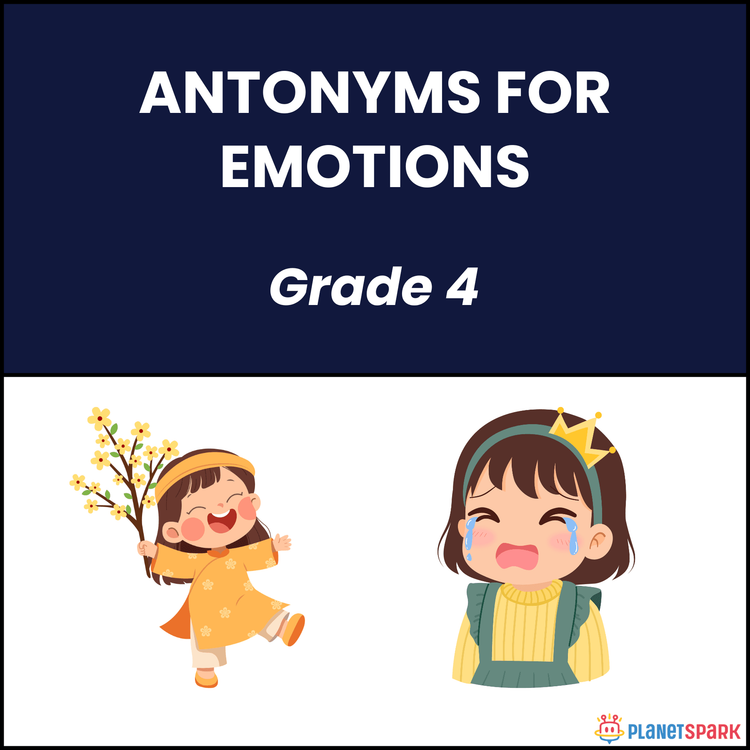
Class 4 Antonyms for Emotions English Worksheet
Feelings and Their Flip Side: Antonyms for Emotions – Class 4
Every emotion has an opposite — and knowing both sides of a feeling makes students stronger readers, more expressive writers, and more emotionally aware individuals. This thoughtfully designed Grade 4 worksheet on Antonyms for Emotions takes students on a journey through the world of contrasting feelings, helping them understand how emotions shift and differ in real-life contexts.
Designed for Class 4 learners, this worksheet explores ten key emotion words: happy, proud, excited, brave, curious, furious, joyful, honest, calm, and confident — paired with their antonyms: sad, ashamed, calm, afraid, indifferent, peaceful, miserable, dishonest, agitated, and relaxed. Through five engaging activity types, students build emotional vocabulary that supports both language learning and social-emotional development.
Why Antonyms for Emotions Matter in English?
Learning antonyms for emotions is a vital vocabulary skill for Grade 4 learners, and here is why:
1. They help students understand character emotions and their changes in stories and reading passages.
2. They strengthen descriptive and creative writing by helping students portray contrasting feelings effectively.
3. They build emotional intelligence by helping children recognise and name opposing emotional states.
4. They expand vocabulary in a meaningful, relatable way — making grammar feel personal and relevant.
What's Inside This Worksheet?
This worksheet includes five well-structured activities that develop emotion antonym skills step by step:
Exercise 1 – Match the Following
Students match each emotion word on the left (happy, excited, proud, brave, furious, curious, joyful, calm, honest, confident) to its correct antonym on the right (sad, calm, ashamed, afraid, peaceful, indifferent, miserable, agitated, dishonest, relaxed). This activity builds foundational understanding of emotion opposites in a clear visual format.
Exercise 2 – Sort the Words
Students sort fifteen word pairs into Antonyms and Not Antonyms columns. Pairs include brave/afraid, excited/calm, Big/Small, Fast/Apple, Bright/Dull, blue/green, Light/Dark, Hot/Rain, Bright/Car, Clean/Dirty, sun/sky, pen/paper, bread/butter, cat/dog, and happy/sad. This activity sharpens the ability to identify genuine antonym pairs versus random or nonsensical word combinations.
Exercise 3 – Fill in the Blanks
Students read ten sentences featuring contrasting emotional situations and fill in the blank with the correct opposite emotion from a given pair — such as selecting ""sad"" when a sibling feels the opposite of happy, or ""agitated"" when a calm sea turns stormy. This tests both vocabulary knowledge and contextual understanding simultaneously.
Exercise 4 – Multiple Choice Questions
Ten multiple-choice questions ask students to identify the correct opposite emotion based on sentence context or direct word meaning — using fresh answer choices designed to encourage genuine thinking rather than guessing.
Exercise 5 – Sentence Rewriting
Students rewrite ten sentences by replacing the incorrectly used emotion word with the correct one. For example, ""He felt sad when his team won the final match"" is rewritten using the word happy or joyful. This is the most creative and challenging activity, pushing students to think critically about emotional meaning and word accuracy.
Answer Key (For Parents & Educators)
Exercise 1 – Match the Following
happy → sad
excited → calm
proud → ashamed
brave → afraid
furious → peaceful
curious → indifferent
joyful → miserable
calm → agitated
honest → dishonest
confident → relaxed
Exercise 2 – Sort the Words
Antonyms
brave/afraid
excited/calm
Big/Small
Light/Dark
Bright/Dull
Clean/Dirty
happy/sad
Not Antonyms
blue/green
Hot/Rain
Fast/Apple
Bright/Car
sun/sky
pen/paper
bread/butter
cat/dog
Exercise 3 – Fill in the Blanks
1. sad
2. calm
3. sheepish
4. afraid
5. angry
6. indifferent
7. boring
8. agitated
9. dishonest
10. timid
Exercise 4 – Multiple Choice Questions
1. d) sad
2. b) calm
3. c) ashamed
4. d) afraid
5. c) irate
6. c) indifferent
7. a) miserable
8. d) calm
9. b) dishonest
10. a) meek
Exercise 5 – Sentence Rewriting (Sample Correct Answers)
1. He felt happy/joyful when his team won the final match.
2. She felt afraid/agitated while watching the horror film alone.
3. The student felt proud after topping the class.
4. The afraid/timid kitten trembled when it saw the balloon.
5. He grew agitated/furious while he shouted at the referee.
6. The child was excited/joyful about receiving the gift.
7. She felt happy/joyful on the day she got promoted.
8. The crowd stayed calm during the peaceful lullaby.
9. The honest witness always told the exact truth.
10. He felt confident right after winning the gold medal.
Empower your Grade 4 child to understand emotions deeply and express them beautifully — join a Live 1:1 English class at PlanetSpark today and nurture their language and emotional intelligence together!
Frequently Asked Questions
Understanding antonyms for emotions helps children recognize and express a wider range of feelings.
Antonyms allow students to describe emotional contrasts, enriching character development and narrative.
Learning antonyms helps children better understand and express their feelings, promoting social and emotional growth.