
Class 4 Prefixes English Grammar Worksheet

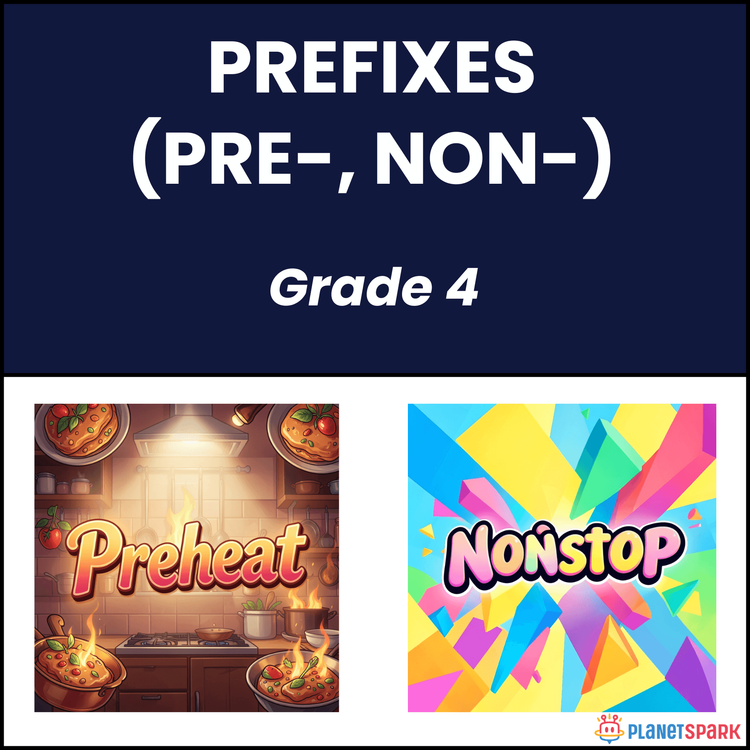
Class 4 Prefixes English Grammar Worksheet
Power Up Your Words: Prefixes (pre-, non-) Worksheet for Class 4
This Grade 4 worksheet on Prefixes (pre-, non-) introduces young learners to one of the most powerful word-building tools in the English language — prefixes. Designed for Class 4 students, this worksheet focuses on two high-frequency prefixes: pre- (meaning ""before"") and non- (meaning ""not"" or ""without""), and how adding them to base words creates entirely new and meaningful words like preview, predict, preschool, nonstop, nonfiction, and nonsense.
Why Prefixes Matter in Grammar?
Understanding prefixes is a vital vocabulary and grammar skill for Grade 4 learners because:
1. It helps students decode the meaning of unfamiliar words by recognising the prefix.
2. It expands vocabulary quickly by showing how one prefix can transform many base words.
3. It builds spelling confidence and strengthens word formation skills.
4. It supports reading comprehension across all subjects, especially in academic and informational texts.
What's Inside This Worksheet?
This worksheet includes five well-structured exercises that develop prefix recognition and application in a fun, age-appropriate way:
Exercise 1 – Match the Following
Students match each base word (e.g., view, dict, stop, sense) to its correct prefix word from the list (e.g., preview, predict, nonstop, nonsense). This foundational activity helps students see how adding pre- or non- changes the meaning of the base word.
Exercise 2 – Sort the Words
Students sort given word pairs into two categories — Prefix pre- and Prefix non-. All pairs in this exercise contain words from both prefix families, and students must correctly identify which word belongs to which group. This sharpens their ability to distinguish between the two prefixes.
Exercise 3 – Fill in the Blanks
Students select the correct prefix word from a pair of options to complete meaningful sentences. For example: ""The teacher gave us a __________ of the chapter."" (preview / nonstop). This contextual exercise reinforces how prefix words are used accurately in real-life sentences.
Exercise 4 – Multiple Choice Questions
Students choose the correct prefix word from four options based on a sentence or definition clue. For example: ""Aryan saw a __________ of the film early."" (a) nonstop b) nonprofit c) preview d) nonsense). This activity builds precision in prefix word identification and contextual understanding.
Exercise 5 – Sentence Rewriting
Students rewrite sentences in which the wrong prefix word or form has been used, replacing it with the correct prefix word. For example: ""We bought the tickets after entering the hall."" must be rewritten as ""We bought the prepaid tickets before entering the hall."" This activity develops editing skills and a deeper understanding of how prefixes change meaning in context.
Answer Key (For Parents & Educators)
Exercise 1 – Match the Following
view → preview
dict → predict
stop → nonstop
sense → nonsense
stick → nonstick
school → preschool
paid → prepaid
profit → nonprofit
fiction → nonfiction
judge → prejudge
Exercise 2 – Sort the Words
Prefix pre-:
preview/prejudge
prepaid/preschool
predict/prejudge
preschool/predict
prepaid/preview
predict/prepaid
prejudge/preschool
preview/predict
Prefix non-:
nonstick/nonprofit
nonstop/nonsense
nonfiction/nonprofit
nonstick/nonstop
nonprofit/nonfiction
nonsense/nonstick
nonstop/nonfiction
Exercise 3 – Fill in the Blanks
1. preview
2. preschool
3. predict
4. nonstop
5. nonfiction
6. prejudge
7. nonstick
8. prepaid
9. nonprofit
10. nonsense
Exercise 4 – Multiple Choice Questions
1. c) preview
2. a) nonfiction
3. d) nonstick
4. b) nonsense
5. a) prepaid
6. d) prejudge
7. b) preschool
8. c) nonstop
9. a) nonprofit
10. c) predict
Exercise 5 – Sentence Rewriting
1. We bought the paid tickets after entering the hall. → We bought the prepaid tickets before entering the hall.
2. The long train had to stop at every station. → The long train was nonstop and did not halt at every station.
3. She made a lot of sense when she started talking. → She spoke nonsense when she started talking.
4. The burnt food stuck to the bottom of the pan. → The food did not stick to the bottom of the nonstick pan.
5. The child went straight to school without any classes before. → The child attended preschool before going to regular school.
6. He paid for the gift only after the party ended. → He had prepaid for the gift before the party began.
7. The charity earned a large profit last year. → The charity was a nonprofit organisation and did not earn profit.
8. She read a fiction book that was entirely made-up. → She read a nonfiction book based entirely on real facts.
9. He judged the team only after watching them play. → He should not prejudge the team before watching them play.
10. She viewed the film well before writing the article. → She got a preview of the film before its official release.
Give your child a vocabulary head start with prefixes through a Free 1:1 English Grammar Trial Class at PlanetSpark — where every word learned opens a new door!
Frequently Asked Questions
Prefixes are added to the beginning of words and change their meanings, helping students understand new words.
Learning prefixes allows students to break down complex words and enhances their understanding of word meaning.
Prefixes help students decode new words more easily and improve vocabulary comprehension.