
Class 4 Suffixes English Grammar Worksheet

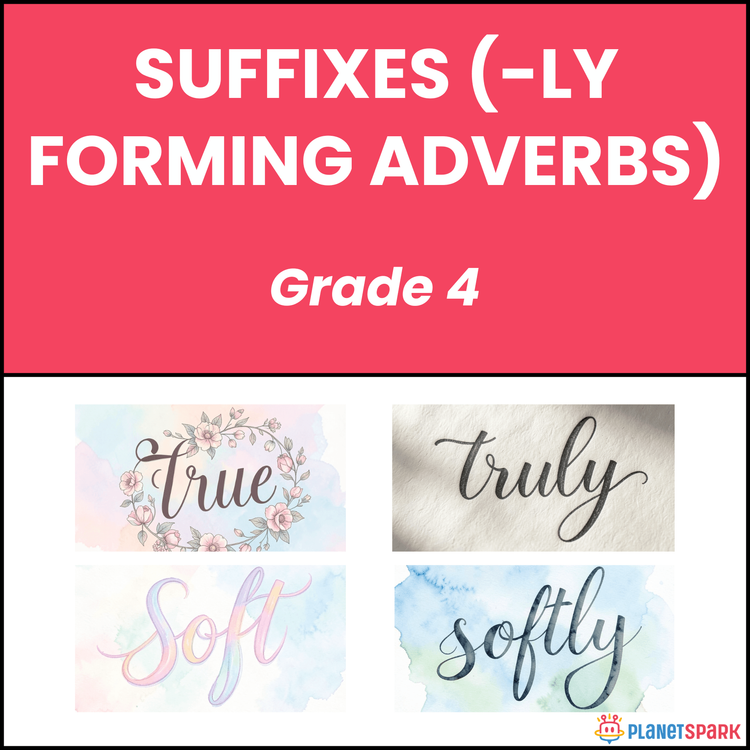
Class 4 Suffixes English Grammar Worksheet
Add -ly, Say It Better: Suffixes (-ly Forming Adverbs) for Class 4
Want your Grade 4 child to write sentences that are more expressive, precise, and polished? This engaging worksheet on Suffixes (-ly forming adverbs) teaches students how adding just two letters to an adjective can completely transform it into a powerful adverb — one that brings verbs and sentences to life!
Designed for Class 4 learners, this worksheet focuses on ten key adjectives — quick, loud, happy, brave, neat, soft, cheerful, graceful, careful, and free — and their -ly adverb forms: quickly, loudly, happily, bravely, neatly, softly, cheerfully, gracefully, carefully, and freely. Students learn how the suffix -ly works, how to form adverbs correctly, and how to use them accurately in a variety of sentence contexts.
Why Suffixes (-ly Forming Adverbs) Matter in English?
Understanding how the -ly suffix forms adverbs is a foundational grammar skill for Grade 4 learners, and here is why:
1. It helps students describe how an action is performed, making their writing more vivid and detailed.
2. It builds word formation awareness, helping students expand vocabulary by recognising patterns.
3. It strengthens sentence construction by teaching students the difference between adjectives and adverbs.
4. It prepares students for more complex grammar concepts in higher grades, such as adverb placement and degree.
What's Inside This Worksheet?
This worksheet includes five well-structured activities that guide students from recognising -ly adverbs to using them fluently:
Exercise 1 – Match the Following
Students match each adjective on the left (quick, happy, loud, brave, soft, neat, cheerful, careful, graceful, free) to its correct -ly adverb on the right (quickly, happily, loudly, bravely, softly, neatly, cheerfully, carefully, gracefully, freely). This activity builds the foundational skill of forming adverbs from adjectives using the -ly suffix.
Exercise 2 – Sort the Words
Students sort fifteen word pairs into Adverb and Non-Adverb columns. Pairs include carefully/free, neat/bravely, happily/loud, quickly/soft, Slow/Slowly, day/nightly, happy/loudly, neatly/brave, cheerfully/care, graceful/freely, nicely/walk, highly/dance, totaly/small, hot/sadly, and quickly/soft. This activity develops the ability to distinguish correctly formed -ly adverbs from adjectives, nouns, or incorrectly formed words.
Exercise 3 – Fill in the Blanks
Students choose the correct -ly adverb from a given pair to complete ten real-life sentences — such as selecting ""quickly"" for Arun finishing before time, or ""gracefully"" for a gymnast balancing on a beam. This tests both adverb recognition and contextual application.
Exercise 4 – Multiple Choice Questions
Ten multiple-choice questions ask students to identify the correct -ly adverb, spot the sentence that uses an adverb correctly, or pick out which word is not an adverb. This format strengthens both grammar knowledge and analytical thinking.
Exercise 5 – Sentence Rewriting
Students rewrite ten sentences by replacing the incorrectly used adjective form with its correct -ly adverb. For example, ""He quick ran to catch the school bus"" is rewritten as ""He quickly ran to catch the school bus."" This is the most hands-on activity, pushing students to apply their understanding of suffix rules in a practical, meaningful way.
Answer Key (For Parents & Educators)
Exercise 1 – Match the Following
quick → quickly
happy → happily
loud → loudly
brave → bravely
soft → softly
neat → neatly
cheerful → cheerfully
careful → carefully
graceful → gracefully
free → freely
Exercise 2 – Sort the Words
Adverb
Slow/Slowly
day/nightly
happy/loudly
cheerfully/care
graceful/freely
neat/bravely
neatly/brave
happily/loud
quickly/soft
hot/sadly
Non Adverb
carefully/free
quickly/soft
nicely/walk
highly/dance
totaly/small
Exercise 3 – Fill in the Blanks
1. quickly
2. loudly
3. softly
4. bravely
5. neatly
6. cheerfully
7. carefully
8. gracefully
9. freely
10. happily
Exercise 4 – Multiple Choice Questions
1. d) quickly
2. c) She sang loudly.
3. c) softly
4. b) cheerful
5. a) gracefully
6. c) carefully
7. b) happily
8. d) cheerfully
9. c) He ran quickly to gate.
10. a) freely
Exercise 5 – Sentence Rewriting (Correct Answers)
1. He quickly ran to catch the school bus.
2. The butterfly freely fluttered in the meadow.
3. Rohan bravely jumped over the wide ditch.
4. Neha neatly arranged her books on the shelf.
5. The children cheerfully decorated the classroom.
6. He softly knocked on the principal's door.
7. She gracefully twirled during the dance performance.
8. They carefully crossed the busy road together.
9. She loudly recited the poem in the hall.
10. He happily waved when he saw his friend.
Give your Grade 4 child the grammar foundation they need to write with confidence and flair — join a Live 1:1 English class at PlanetSpark today!
Frequently Asked Questions
Suffixes are added to the end of words and change the word's function or meaning, helping students understand grammar better.
By learning suffixes, students can predict the spelling of new words.
Practicing suffixes helps students form adjectives, adverbs, and nouns from root words, improving sentence variety.