
Class 3 Regular and Irregular Verbs Worksheet

Class 3 Regular and Irregular Verbs Worksheet
Verb Time Travel: Regular and Irregular Verbs for Grade 3
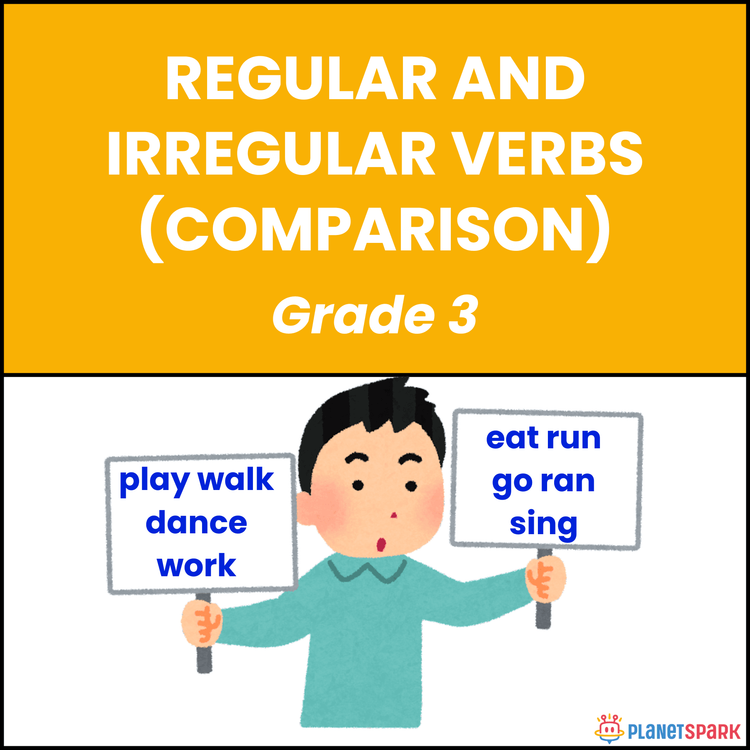
This Grade 3 worksheet on Regular and Irregular Verbs (Comparison) helps young learners understand how verbs change from present tense to past tense. Through structured and engaging activities, students learn to identify, compare, and correctly use both regular verbs (that add -ed) and irregular verbs (that change form completely).
Why Regular and Irregular Verbs Matter in Grammar?
Understanding verb forms is essential for building strong sentence construction skills. In Grade 3, students begin mastering past tense forms, and this worksheet supports that learning by:
1. Teaching the difference between regular and irregular verb patterns.
2. Strengthening sentence correction and editing skills.
3. Improving grammar accuracy in writing and speaking.
4. Helping learners confidently use correct verb forms in real-life situations.
What’s Inside This Worksheet?
This worksheet includes five grammar-rich exercises designed to build clarity and fluency in verb usage:
Exercise 1 – Multiple Choice Questions
Students choose the correct past tense form of the verb from two given options. This sharpens recognition of irregular verb changes such as go → went and buy → bought.
Exercise 2 – True or False
Students carefully read sentences and identify whether the verb form is correct. This activity strengthens error detection and grammar awareness.
Exercise 3 – Fill in the Blanks
Learners complete sentences using the correct past form of verbs provided in brackets. This builds application skills and reinforces spelling of irregular verbs.
Exercise 4 – Sentence Rewriting
Students rewrite present tense sentences into correct past tense forms. This improves sentence transformation and tense accuracy.
Exercise 5 – Passage-Based Verb Practice
A short story requires students to fill in blanks using the correct past tense verbs from a word box. This integrates grammar learning into contextual writing.
This worksheet ensures that children don’t just memorize verb forms but understand how and when to use them correctly in meaningful sentences.
Answer Key (For Parents and Educators)
Exercise 1 – Multiple Choice Questions
1. b
2. a
3. b
4. a
5. a
6. b
7. a
8. b
9. b
10. a
Exercise 2 – True or False
1. T
2. F
3. T
4. F
5. F
6. T
7. F
8. T
9. T
10. F
Exercise 3 – Fill in the Blanks
1. lit
2. played
3. brought
4. flew
5. recited
6. prepared
7. slept
8. visited
9. drew
10. drank
Exercise 4 – Sentence Rewriting
1. We waited for him at the bus stop.
2. My teacher gave me a star in the notebook.
3. She told us a funny story to make us laugh.
4. I helped my dad wash the car.
5. The frogs jumped into the pond.
6. They cleaned the whole house before the party.
7. I studied my spelling words every night.
8. Monkeys climbed trees very quickly.
9. I swam in the pool during the summer.
10. Sometimes, the sky turned grey.
Exercise 5 – Passage-Based Verb Practice
1. drove
2. pushed
3. found
4. picked
5. went
6. smelled
7. bought
8. scanned
9. paid
10. carried
11. reached
12. helped
13. said
14. laughed
Help your child confidently master regular and irregular verbs with expert-led grammar practice today.
Frequently Asked Questions
Regular verbs follow a pattern by adding “ed,” while irregular verbs change differently, which is a core comparison in Class 3 grammar worksheets.
Knowing common irregular verbs improves reading fluency and writing accuracy in CBSE English.
Parents can use flashcards or sentence-building games to make grammar practice engaging for early learners.