
Class 5 English Worksheet on Commas in Compound Sentences

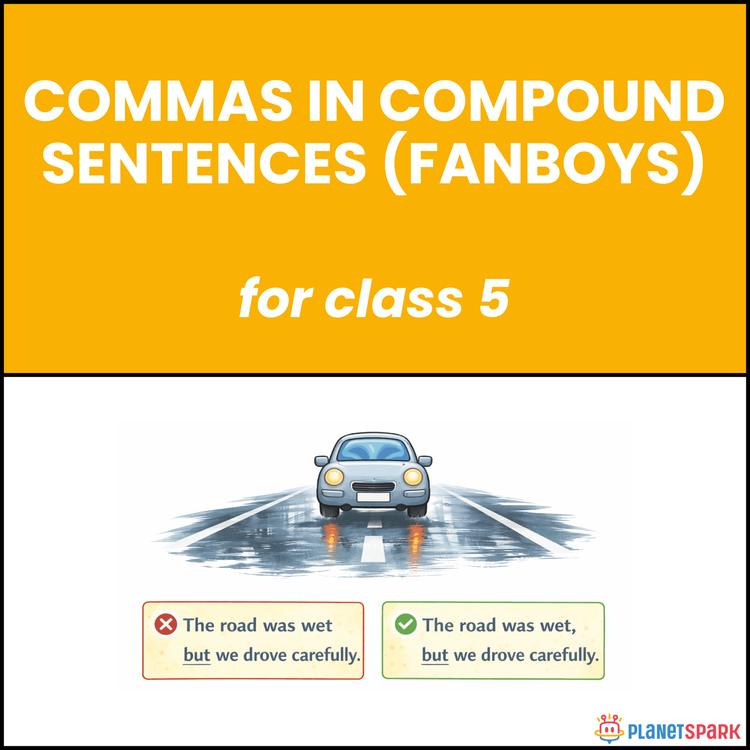
Class 5 English Worksheet on Commas in Compound Sentences
Comma Power Play: Mastering FANBOYS in Compound Sentences for Class 5
This Grade 5 worksheet focuses on helping students understand and correctly use commas in compound sentences using FANBOYS (for, and, nor, but, or, yet, so). Through a variety of structured and engaging exercises, learners build clarity in sentence formation and punctuation.
Why Commas in Compound Sentences Matter in Grammar?
Commas play an important role in separating ideas and improving sentence clarity. For Grade 5 learners, this topic is important because:
1. It helps join two complete sentences correctly using conjunctions.
2. It prevents confusion and run-on sentences.
3. It improves both writing and reading fluency.
4. It strengthens overall sentence structure and grammar accuracy.
What’s Inside This Worksheet?
This worksheet includes five grammar-rich activities that strengthen punctuation skills:
🧠 Exercise 1 – Multiple Choice Questions
Students choose the correctly punctuated compound sentence from given options, focusing on comma placement before conjunctions.
✔️ Exercise 2 – True or False
Students evaluate statements related to comma rules and FANBOYS, helping reinforce conceptual understanding.
✏️ Exercise 3 – Fill in the Blanks
Students complete sentences by adding suitable conjunctions along with proper comma usage.
🔄 Exercise 4 – Sentence Rewriting
Students rewrite sentences by correcting comma placement, improving editing and proofreading skills.
📝 Exercise 5 – Paragraph Writing
Students rewrite a paragraph by inserting commas correctly in compound sentences, promoting real-world writing application.
This worksheet gradually builds from recognition to application, ensuring strong grammar retention.
✅ Answer Key (For Parents & Educators)
Exercise 1 – Multiple Choice
1. b 2. c 3. a 4. b 5. c 6. a 7. c 8. b 9. b 10. a
Exercise 2 – True or False
1. True
2. True
3. False
4. False
5. False
6. False
7. False
8. True
9. True
10. True
Exercise 3 – Fill in the Blanks (Sample Answers)
1. but
2. but
3. and
4. but
5. so
6. so
7. but
8. so
9. so
10. so
Exercise 4 – Rewritten Sentences
1. She was tired, but she finished her work.
2. He wanted to help, yet he did not know what to do.
3. The baby was crying, so the mother picked her up.
4. I wanted to call you, but I forgot.
5. The team played well, and they won the match.
6. He did not study, nor did he complete his homework.
7. We can go now, or we can wait for some time.
8. She stayed quiet, for she was feeling upset.
9. The road was empty, yet we drove slowly.
10. He was hungry, so he ate quickly.
Exercise 5 – Paragraph Writing (Corrected Version)
The morning was calm, but the streets were already busy, and people were walking quickly, yet some shops were still closed, for the owners had not arrived, and a few customers waited outside, so the area slowly became crowded, but no one seemed impatient, and the vendors started arranging their goods, yet the noise began to grow, and everyone continued their work, but the atmosphere stayed lively.
Make punctuation simple and powerful—help your child write clearer, smarter sentences with guided grammar practice.
Frequently Asked Questions
Commas separate independent clauses when linked by conjunctions like “and,” “but,” or “so.”
They may overlook the pause needed between clauses, focusing only on the conjunction.
Use simple examples with easy conjunctions to practice sentence-building in games or activities.